Verified flushing evidence
A tick is a claim. A temperature jump is evidence.
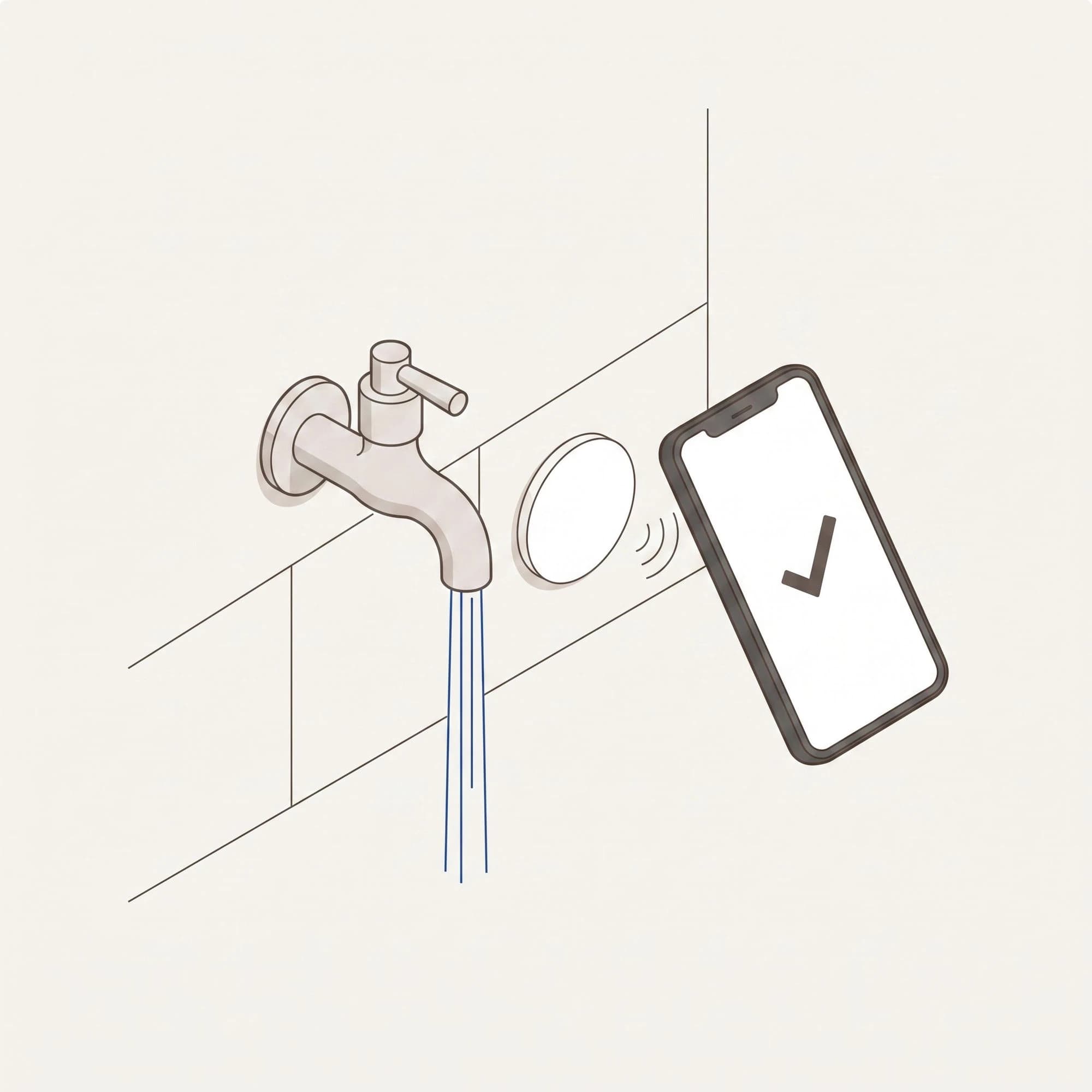
Anyone can tick a box. With LegioLog your employee taps every tap when flushing, and the sensor shows for each flushing round whether hot water came out of the installation. That is the difference between saying you did it and showing that it happened.
The problem
Paper checklists prove nothing
A ticked flushing list only says that someone ticked a box. Not when, not whether the tap really ran long enough, and not whether the water got hot enough. Who checks the checker? At an inspection or an insurance claim, what counts is not what you wrote down, but what you can show.
How it works
Scan, flush, confirmed
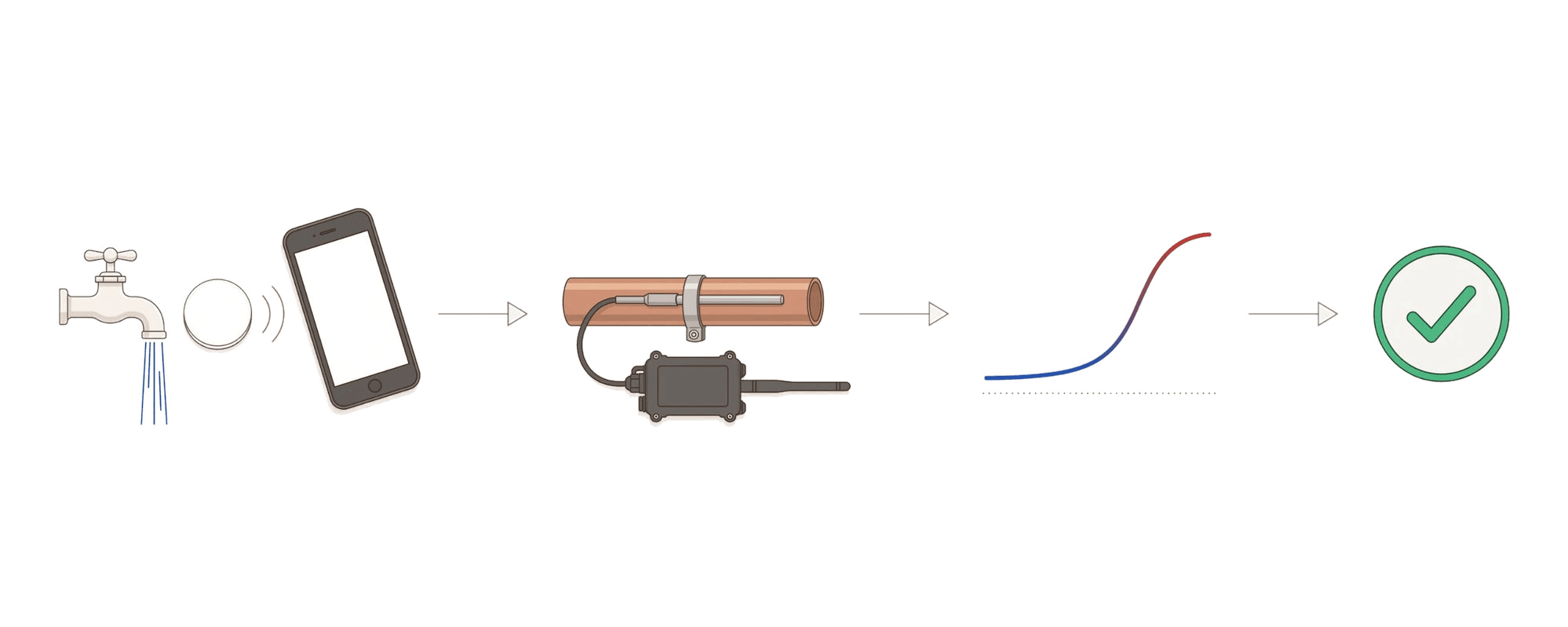
Your employee holds the phone against the tag at each tap and lets it run until the timer reaches zero. All taps on the same hot water installation together form one flushing round. The sensor on the hot pipe leaving the water heater sees all the water of that installation pass by. If the pipe reaches the threshold of that installation during the round (55 °C by default, or the value your country prescribes), hot water came out of the installation. Half an hour after the last tap the result is in the logbook: the tap where the temperature jumped shows Verified: jump, the other taps of that round show Pipe at temperature.
To be fair
No jump? Then no tick
If no hot water came out of the installation during the flushing round, LegioLog does not confirm the round. The taps are recorded as not verified in the logbook, and you get one alert for the whole round. That way you see in black and white where the flushing could not be shown, and you can put it right before an inspector finds it.
Hotels and circulation pipes
A loop is always hot, so the loop does not prove a flush
With a circulation pipe, as in most hotels, the loop stays at temperature day and night. A tap that opens changes nothing there, so the sensor on the loop cannot show a flush per room. What LegioLog does there: the loop is monitored (if it stays at temperature you see that, if it drops you get an alert), and every flush is in the logbook with the tap, time and name. If you also want evidence per wing that hot water flowed through the branch, that is an option with an extra probe on that branch; only for such a branch with its own probe does the logbook show Verified.
Why this carries more weight
With the inspector and the insurer
For the inspector
a verified flush is objective evidence, not a signature you put there yourself.
For your insurer
in a claim you show that the management was demonstrably in order, with time, place and reading.
For yourself
you see for each flushing round whether hot water came out of the installation, instead of relying on a checklist.